Green Eyed Monster


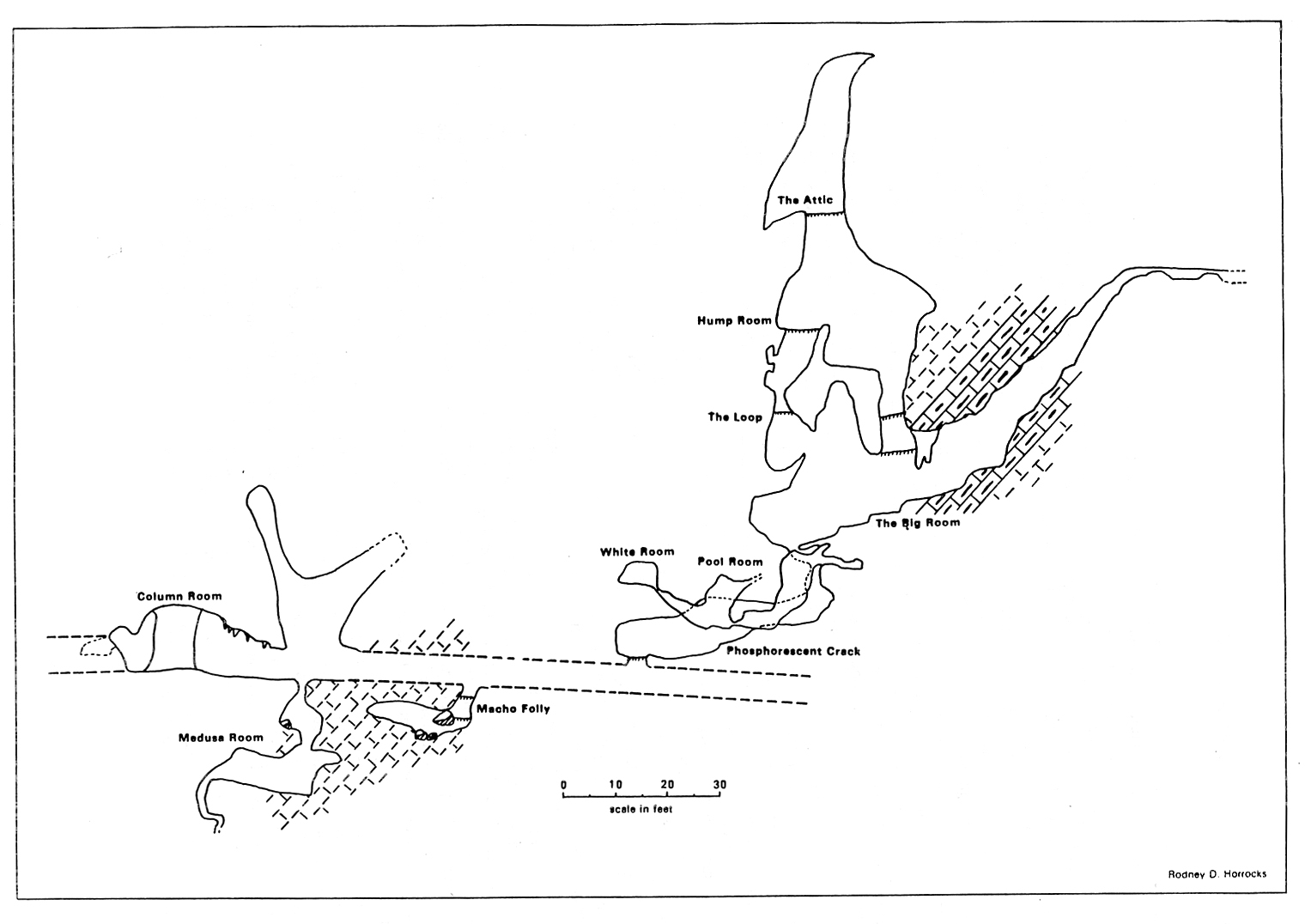
Green Eyed Monster is another cave that never would have been seen if some miners didn't happen to dig right into it. After a tight squeeze at the bottom of this corrugated tube, the mine drift continues for quite a ways until it broke into the cave. The features inside are very interesting and most have a strange green tint to them.

You can find plan and profile maps here:
http://www.jonjasper.com/MapGallery/GreenEyedMonster.jpg ,
http://www.jonjasper.com/MapGallery/GreenEyedMonsterProfile.jpg


The entrance. Permission must be obtained by the land owner before entering the mine.

Jeff and John in "The Big Room"

Cameron & Jeff in "The Big Room"


Cameron climbing into the "Hump Room".

Looking up into the "Attic".

A small rimstone pool in "The Loop".


Cameron in "The Phosphorescent Crack".

Spencer in "The Phosphorescent Crack".

The entire group in "The Column Room" (From left to right: John, Cameron, Sam, Scott, Jeff, Spencer, Shane [behind the camera])

Our guides Scott and Sam ( S & S Adventures) in "The Column Room".


Shane standing between two columns in the "Hump Room".

Spencer squeezing through the tight spot on "The Loop".
This cave easily makes our top 10 list because of the quantity and size of the formations, the large rooms and beautiful colors.

The following pictures were taken in the Medusa Room on the original discovery trip made back in 1973. Images are courtesy of Stephen Kendorski.


READMORE
 

White Nose Syndrome


What is white-nose syndrome?
Hibernating bats in the northeastern United States are dying in record numbers, and we do not know the cause of the deaths. This wildlife health crisis, white-nose syndrome, is named for the white fungus evident on the muzzles and wings of affected bats.


How is WNS transmitted?
The U.S. Fish & Wildlife Service believes that WNS is transmitted primarily from bat to bat. There is a strong possibility that it may also be transmitted by humans inadvertently carrying the causative agent from cave to cave on their clothing and gear.

What should cavers know and do?
The Service and the states request that cavers observe all cave closures and advisories and avoid caves, mines or passages containing hibernating bats to minimize disturbance to the bats. The Service asks that cavers and cave visitors stay out of all caves in the affected states and adjoining states to help slow the potential spread of WNS.

It is also advise that you decontaminate previously used gear immediately, store them away, and thoroughly wash and decontaminate any surfaces with which these items may have come into contact (e.g., car trunk, duffle bag, etc.). Currently, 10% bleach solution, Lysol® All-purpose Professional Cleaner, and the antibacterial form of Formula 409® have been demonstrated to be effective at killing Geomyces sp., the fungus associated with WNS, on nonporous surfaces.

For a complete list of decontamination procedures for cavers click here.


For more information, see http://www.fws.gov/northeast/white_nose.html.
Federal Relay Service for the deaf and hard-of-hearing
1 800/877 8339
U.S. Fish & Wildlife Service
1 800/344 WILD
www.fws.gov
WhiteNoseBats@fws.gov

(The above information is taken from the U.S. Fish & Wildlife Service White-nose syndrome in bats Frequently Asked Questions publication available here)
READMORE
 

Bowl Cave

This cave is located in a small bowl directly behind an old mill. It is very small as we were only able to measured 11' of length. The only formations found inside were a couple of very small pieces of bacon on the ceiling.


The entry is pretty well hidden behind some trees, but it is not hard to find if you are looking for it.

This tiny piece of bacon is the only formation we found.

This is a picture of the old mill/smelter. The cave is located just behind it in the bowl.
READMORE
 

Ireko Cave

Ireko Cave follows a limestone fissure straight back into the mountain and has a very strong breeze coming out of it. We measured 110' from the entrance to the squeeze that was too tight for me to comfortably try on my own. When I tossed a rock through the pinch point I could hear it roll for a good 6 seconds. With how much air movement there is in this cave I would expect it to continue on much further.


You can see an old PVC canister with aluminum lids on it laying on the floor in the photo above. The only reason I think that it could be there was that it was used to haul dirt out of the cave.

This cave has a lot of small stalagmites and soda staws.

This is the tightest squeeze in the cave. As you can see, it was not much bigger than my helmet. I was able to fit through it with some wiggling, but I don't think Shane would have made it. He waited for me on the other side of this squeeze.

Just past the tight squeeze there is an open fissure headed up into the ceiling. We did not get a chance to explore it on this trip however.

I was a little weary about squeezing through this one. It did not look much bigger than my boot, but once I got down in it I slipped through pretty easily.

A little past the third squeeze we found a off shoot. It was tight and made two 90 degree bends fairly close to each other, so I did not attempt it this trip either.

I stuck my camera around the corner of the turn off and you can clearly see it opens up to another passageway. We will have to go back up for another mapping trip.

These two small stalagmites remind me of the "salt and pepper shaker" in Timpanogos Cave.

At the end of this tunnel is where the tightest squeeze was encountered, and with no one there that could pull me out if I were to get stuck.... I decided not to push it. When I tossed a rock through it I was surprised to hear it bounce and fall for a good 6 seconds before coming to a rest. The airflow through this squeeze was very strong and cold, just as it had been through the entire cave. This is a great indicator that there is a lot more passage to explore.

Right before the last squeeze we found this old anchor bolted into the wall. I was very surprised to think that anyone else could fit through that hole if I couldn't.

Hiking up to the cave I discovered this small solution tube that day lighted at the top through a crack in the cliff. This was a very encouraging sign that Ireko may be close since we did not know of it's exact location.


We also found this interesting caterpillar. I believe it is a spotted tussock moth caterpillar.

And a Tarantula crossing the road.
READMORE